Sales
Best MSP Sales Consultants and Coaches in 2026
C4 Solutions, Feel-Good MSP, MSP Sales Partners, MSP Sales Revolution, and MSP Growth OS — each built for a different engagement model, from embedded fractional leadership to self-paced training to AI-specific coaching.

Last updated: September 2026
Five sales consultants get pulled into every "best of" list for MSPs. Almost none of them do the same job.
The best MSP sales consultants for 2026 are C4 Solutions, Feel-Good MSP, MSP Sales Partners, MSP Sales Revolution, and MSP Growth OS, each built for a different engagement model, from embedded fractional leadership to self-paced training to AI-specific coaching.
That distinction matters more than a ranking number. If you hire a peer-practice roleplay program when what you actually need is someone sitting in your pipeline reviews, you'll burn three months figuring out the mismatch and still be short a sales leader.
MSP sales help splits into five real categories, not one. Fractional leadership (C4, MSP Sales Partners), self-paced or coached training (Feel-Good MSP), AI-specific sales systems (MSP Sales Revolution), and peer-practice roleplay (MSP Growth OS). Pricing is published for exactly one provider on this list. The rest hide behind "book a call." Pick based on whether your gap is process, coaching, management, or reps.
This list ranks providers by what they actually do, who they're built for, and what they cost. See our MSP sales consulting page for how C4 structures this work. Pricing where it's published. A note where it isn't.
Quick Answer
If you want sales tied into a full marketing and growth system, C4 Solutions is the pick. If you want a published, three-tier program with real pricing, go with Feel-Good MSP. Need embedded fractional sales leadership and someone managing your SDRs day to day? MSP Sales Partners. Trying to sell AI specifically, not general MSP services? MSP Sales Revolution. Team already knows the theory and just needs reps? MSP Growth OS, formerly MSP Dojo.
How Do MSP Owners Actually Choose Between These?
Three things mattered. Engagement model, because "sales consultant" covers five genuinely different jobs. Stage fit, because a solo founder still closing every deal needs something different than a $7M shop with a sales team that's inconsistent. And pricing transparency, because half this market hides behind "book a call" and that tells you something too.
We're not neutral here. C4 Solutions is on this list and it's our company. We built the ranking around what a buyer needs to know before they spend money, not around making ourselves look good. Where a competitor does something better, we say so.
C4 Solutions
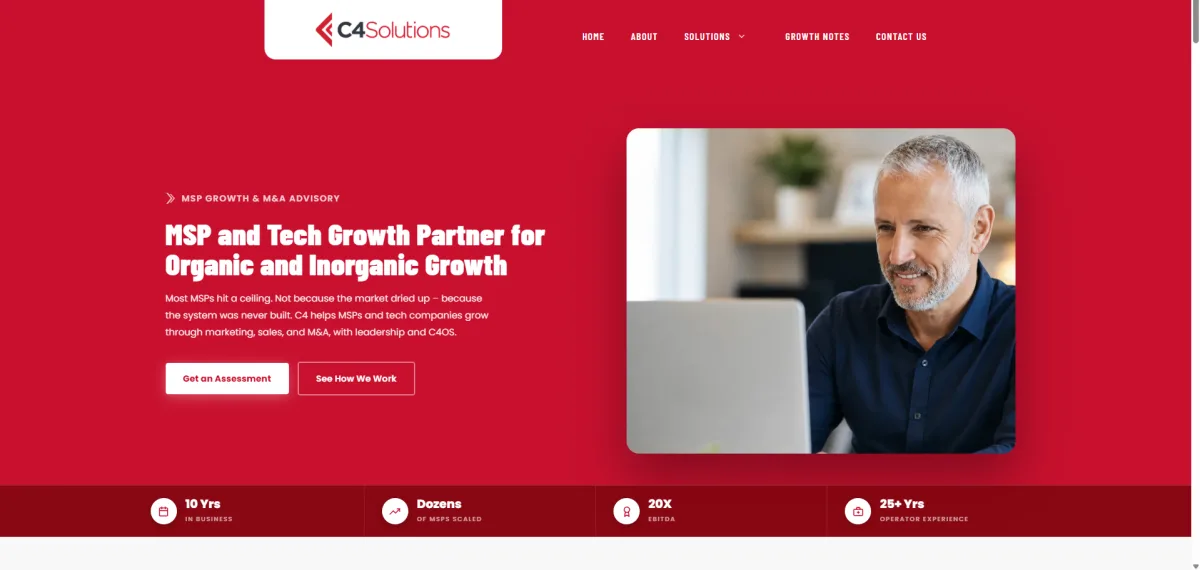
C4 doesn't sell sales training. It builds the sales function itself, process, hiring, compensation, pipeline, inside the same engagement that fixes marketing and positioning first. Full details on that approach are on C4's sales consulting page.
That's the part competitors on this list don't do. Feel-Good MSP will train your team to sell better. MSP Sales Partners will run your SDR function. Neither one touches whether your positioning is actually right before they start filling your pipeline with leads that don't convert.
C4's core argument is that a sales problem is rarely a sales problem. It's a systems problem wearing a sales costume. A founder hires a salesperson, hands them a CRM and a prospect list, and waits. Six months later there's minimal pipeline and a conversation about whether the hire was the right fit. They probably weren't the problem. Nobody defined the process, set clear expectations, or built an accountability system that catches trouble before it compounds. Good people fail inside broken systems, every time.
The engagement covers sales process engineering, hunter versus farmer hiring strategy (a distinction most MSPs never make explicitly, and it shows in who they hire), compensation design tied to actual outcomes, and pipeline visibility through C4OS, the firm's own operating system. Every engagement tracks pipeline coverage, conversion rate, and follow-up cadence as measurable variables. When the numbers are bad, something specific broke. That's a diagnosable problem, not a vibe.
Here's the honest tradeoff. C4 doesn't run a self-serve training library. There's no $399 a month tier where a founder logs in and watches videos on their own schedule. Every engagement starts with a foundation phase, positioning and messaging locked before any sales activity launches, which means it's slower to start than signing up for Feel-Good MSP's Foundations tier this afternoon. If you want something you can begin today with no onboarding call, that's not this.
What you get instead is sales that's actually connected to the rest of the business. C4 runs marketing (SEO, AEO, GEO, LinkedIn, YouTube, paid media), sales, and M&A advisory under one roof, with C4OS starting at $595 a month powering pipeline visibility across all three. That matters more than it sounds like it should. A sales process built in isolation from marketing positioning tends to fall apart the moment the two functions disagree about who the ideal client actually is.
Founded in 2017 by operators with over 25 years of experience building and exiting technology companies, C4 works with MSPs, IT service providers, VARs, telecom companies, and SaaS and technology firms.
Best fit for MSP owners who suspect their sales problem is actually a positioning problem, and who want one partner accountable for both instead of stitching together a trainer and an agency and hoping they talk to each other.
Feel-Good MSP
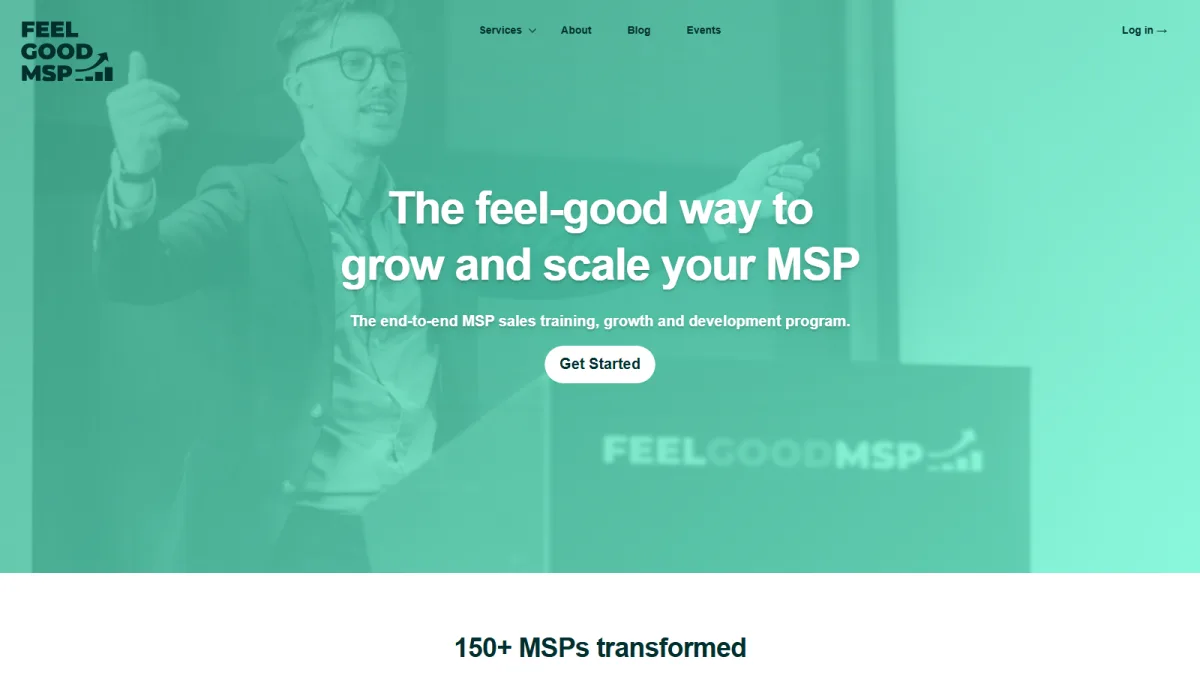
Brian Gillette has spent over a decade helping MSP owners build structured sales organizations, according to the company's own about page, after leading sales inside an MSP himself and feeling firsthand what happens when growth depends entirely on the founder. Feel-Good MSP now runs a team of five, per public org data.
Three tiers, published, no "contact us for a quote" hiding behind a form. Feel-Good Foundations runs $399 a month after a $1,500 first-90-days onboarding, aimed at founders still doing most of the selling themselves. Sales Accelerator is $2,500 a month for a minimum 12 months, built for MSPs with a sales leader and a team that needs a consistent process instead of everyone winging it differently. Executive Partnership runs $10k to $25k a month for fractional CRO or VP of Sales work, custom scoped.
That range covers nearly the entire market this list is trying to serve. A $1.5M MSP and a $12M MSP can both find a tier that fits, which almost nobody else here can say.
The philosophy is "anti-FUD." Gillette teaches consultative selling built on trust rather than fear-based urgency tactics, which matters in a channel where a lot of legacy sales training still leans on scare-based security pitches. Twenty-plus named testimonials sit on the site, not the vague "many clients love us" language most competitors default to. Reviewers consistently mention the training reframing how they think about sales conversations, less about closing and more about diagnosis.
Where it falls short of C4 is scope. Feel-Good MSP fixes how your team sells. It doesn't touch whether your positioning is right before the leads show up, and it doesn't run marketing, M&A, or any function outside sales training and coaching. If your problem is that marketing generates activity but not qualified pipeline, this won't fix that half of the equation.
Best for MSP owners who want to start immediately, know their scope is specifically sales training rather than a full system overhaul, and want to see the exact number before they book a call.
What Does MSP Sales Partners Actually Do Differently?
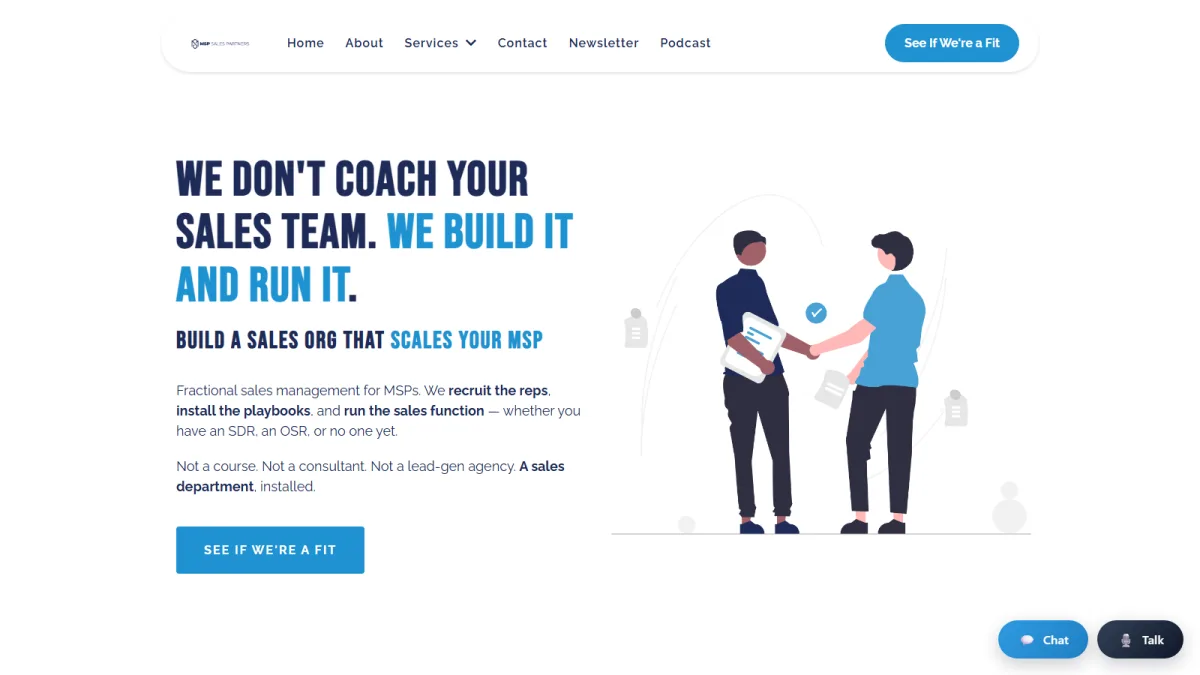
Ray Green spent 20 years in sales leadership before this, including heading sales for Robin Robins, the largest IT business coach globally, and serving as Expert in Residence for sales at TMT. That background is the entire pitch. He's reviewed more than 10,000 sales calls and managed north of $250M in revenue across the MSPs and IT businesses he's coached, per MSP Success (2026).
MSP Sales Partners launched in January 2025 and grew to five-plus full-time hires within its first year, including dedicated sales managers who support the fractional engagements. That's fast growth for a company this age, and it signals real demand rather than a solo consultant testing the waters.
The core offer is fractional sales management, embedded sales leadership without the roughly $250k a year a full-time VP of Sales costs once you add salary, benefits, and the risk of a bad hire. The pitch draws a specific contrast with generic fractional providers. A typical fractional sales leader starts around $5k a month, splits attention across three or four clients, and has no backup if they're out sick or leave. MSP Sales Partners positions itself as a full delivery team instead, with built-in redundancy and a standardized operating system rather than one person juggling a portfolio.
Two other services round it out. A 360-degree Sales Audit, a 6 to 8 week diagnostic that identifies where the sales process actually breaks, billed as a one-time engagement. And an SDR Accelerator for recruiting, training, and managing sales development reps, since Green's read on the market is that most MSPs hire an SDR and then have nobody available to coach or support them.
Per trade coverage in MSP Success, the audit runs as a one-time charge while SDR Champions and Fractional Sales Management are billed as ongoing monthly services. Pricing available on request.
Compared to Feel-Good MSP, this is a heavier, more hands-on engagement. Feel-Good trains your existing team. MSP Sales Partners largely becomes your sales management layer. Best for MSPs that have salespeople but no sales leader, and don't want to hire one full-time yet.
MSP Sales Revolution
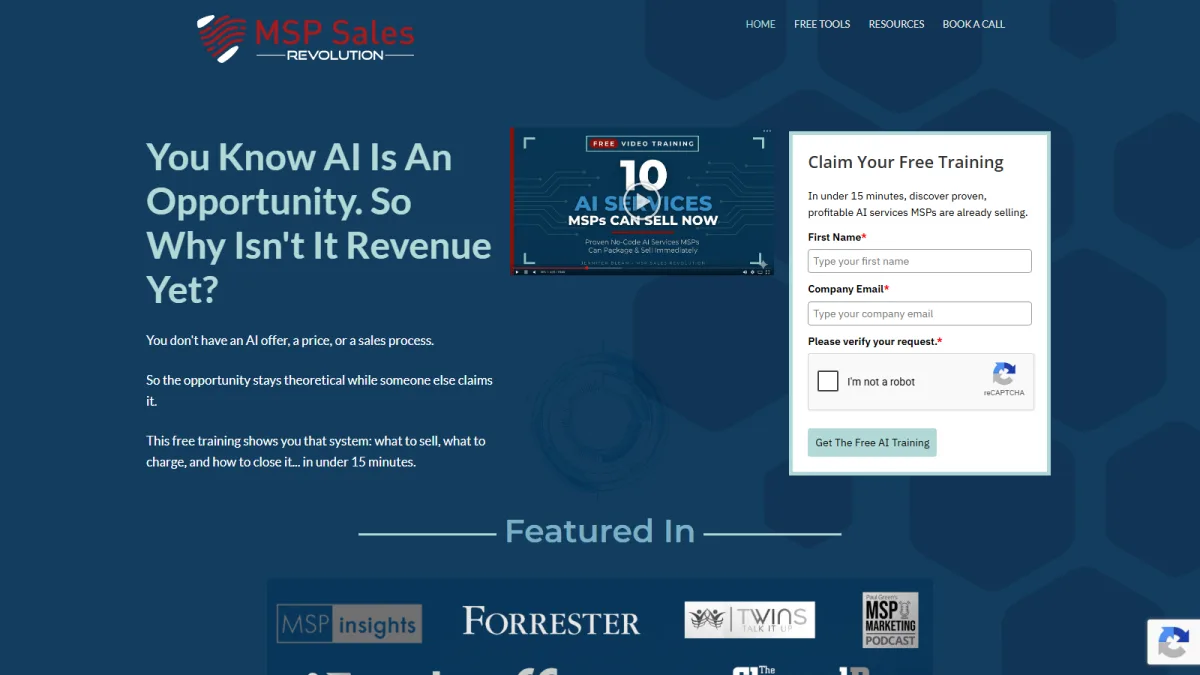
Jennifer Bleam isn't selling general MSP sales training anymore. MSP Sales Revolution has narrowed hard into one thing: helping MSPs sell AI services specifically.
The AI Revenue Engine is a six-month program built around what to offer, what to charge, and how to close AI advisory work without overpromising or sounding unprepared in front of a client. Bleam is a bestselling author ("Simplified Cybersecurity Sales for MSPs") and built a CLOSE AI Method and an AI Readiness Scale as proprietary frameworks inside the program.
This is the narrowest offer on the list, and that's the point. If your actual problem is general sales process, hiring, or team structure, this isn't built for that. It solves one specific, timely problem: MSPs see AI as an opportunity but don't have a system for selling it, pricing it, or having the conversation without sounding like they're guessing.
Pricing is undisclosed. Booking a call is the only way to get a number.
Best for MSPs who already have a working sales process and specifically need help packaging and selling AI advisory services as a new line of business.
MSP Growth OS (formerly MSP Dojo)
MSP Dojo used to be its own thing, a live-practice community founded by Robert Gillette where MSP sales reps roleplayed real scenarios with each other instead of practicing on actual prospects. In 2025, MSP Growth OS acquired it.
That matters for anyone evaluating this option. It's not a standalone consultancy anymore. It's a component folded into a broader system built by Dave Sagraves and Robert Gillette, one that also includes the TRUST Methodology Sagraves used to grow his own MSP to $143M in annual revenue, packaged as an academy alongside the practice sessions.
The core idea behind the original Dojo still holds. Knowing what to do in a sales conversation and being able to actually do it under pressure are different skills. Weekly virtual sessions work through common objections and scenarios in small groups, sometimes one-on-one with experienced practitioners the program calls Black Belts.
Pricing is undisclosed.
Best for sales teams that already have the theory down and specifically lack reps. Not the pick if you need someone to build your sales process from scratch, since that's more the Growth OS Academy's territory now than the original Dojo's narrow practice focus.
Compare the Options
What Actually Separates These Providers?
Feel-Good MSP and MSP Sales Partners both improve how your existing sales function operates. Feel-Good does it through training your people. MSP Sales Partners does it by putting an experienced team on top of your people. If you already have salespeople and the problem is coaching and process, Feel-Good is the lighter lift. If the problem is nobody managing the reps day to day, MSP Sales Partners is closer to actually solving it.

C4 sits in a different category entirely. It's the only option here that treats sales as one output of a system that also includes positioning and marketing, not an isolated function you can fix on its own. That's a real strength if your sales numbers are bad because your ICP or messaging is wrong. It's also the slowest to start, since the foundation phase runs before sales activity launches.
MSP Sales Revolution and MSP Growth OS both solve narrower problems than the other three. Sales Revolution is AI-specific. Growth OS is practice-specific. Neither one is trying to be a full sales system, and treating them like one is the mismatch that wastes a quarter.
What Does an MSP Sales Consultant Actually Do?
An MSP sales consultant helps a managed service provider design, install, or run the systems that turn leads into closed deals and closed deals into predictable, repeatable revenue. That covers sales process design, team structure and hiring, compensation, pipeline management, and in some models, direct coaching or hands-on management of the sales function.
The term gets applied loosely across five different business models, which is exactly why buyers end up confused comparing a training platform to a fractional executive.
Common Questions
Is a sales consultant different from a fractional CRO?
Usually yes, though the terms blur. A fractional CRO or VP of Sales typically embeds at the executive level, owns strategy, and often manages the sales team directly, closer to what MSP Sales Partners and C4's engagement model offer. A sales consultant more often trains, coaches, or advises without taking day-to-day ownership of the function, closer to Feel-Good MSP's Foundations tier or the original MSP Dojo model.
How much should an MSP budget for outside sales help?
It depends entirely on the model. Self-paced training runs a few hundred dollars a month. Fractional sales leadership clusters tightly around $5,000 to $15,000 monthly across multiple 2026 market benchmarks, with $6,000 to $10,000 as the most common range for a typical 10 to 20 hour weekly engagement. Full-time sales leader salaries start around $150k and climb past $250k once benefits and ramp risk are factored in.
Do I need MSP-specific experience, or will any sales consultant work?
MSP-specific experience matters more here than in a lot of B2B categories. Managed services selling involves long sales cycles, recurring revenue economics, and buyer trust dynamics that look nothing like transactional software sales. A generalist consultant who's never sold an MRR-based service will spend your first few months learning your market instead of fixing it.
What's the difference between this and an MSP marketing agency?
A marketing agency generates leads. A sales consultant or fractional sales leader converts them. Some MSPs hire both and never connect the two, which is its own failure mode. If your close rate is bad because the leads coming in aren't actually qualified, the fix is on the marketing side, not the sales side, and no amount of sales coaching solves a lead quality problem.
Can I just train my existing salesperson instead of hiring outside help?
Sometimes. If you already have someone with real sales aptitude and the gap is process and coaching rather than talent, a training program like Feel-Good MSP's Foundations tier can close that gap for a few hundred dollars a month. If the gap is that nobody's actually managing the sales function day to day, training alone won't fix an accountability problem.
Where to Start
If sales feels random and you suspect it's connected to a bigger positioning problem, talk to C4 about a foundation-first engagement that fixes positioning and sales process together, not sales in isolation. If you know the fix is narrower, training your current team or adding fractional management, the other four providers on this list are worth a direct look.
Sales inconsistency rarely stays contained to sales. It shows up in valuation conversations eventually too, when a buyer asks how much of the pipeline depends on the founder personally. That's a different problem with the same root cause, and it's worth understanding both before picking a fix.
About the author
Holly Mack is a Fractional CMO at C4 Solutions, focused on MSP and B2B technology marketing. She leads growth strategy, content systems, and marketing operations for MSPs and tech companies across North America.
Frequently Asked Questions
Is a sales consultant different from a fractional CRO?
Usually yes, though the terms blur. A fractional CRO typically embeds at the executive level and owns strategy, while a sales consultant more often trains or advises without day-to-day ownership.
How much should an MSP budget for outside sales help?
Fractional sales leadership clusters around $5,000 to $15,000 monthly across multiple 2026 market benchmarks, with $6,000 to $10,000 as the most common range.
Do I need MSP-specific experience, or will any sales consultant work?
MSP-specific experience matters more here than in most B2B categories, given long sales cycles and recurring revenue economics.
What’s the difference between this and an MSP marketing agency?
A marketing agency generates leads. A sales consultant or fractional sales leader converts them.
Can I just train my existing salesperson instead of hiring outside help?
Sometimes, if the gap is process and coaching rather than a lack of day-to-day sales management.
Fix the sales function, not just the lead flow.
Book a 30-minute Growth Strategy Call — we’ll diagnose what’s stalling and map the next 90 days.